
 0
0
Most of the time, nothing is wrong. 🌿
What you’re experiencing is one of the most common and least discussed hair phenomena of the year: seasonal fall shedding. It peaks in September and October, affects a significant percentage of women, and is driven by a completely natural biological process. But for active women — already putting hair through traction, sweat, and friction every training session — seasonal shedding can feel more alarming than it needs to be.
At Ahimsa, we believe understanding what’s happening to your hair is the first step toward responding to it wisely. This post explains the science behind fall shedding, why active women experience it more acutely, and exactly what to do about it. 💚
First: Is This Actually Happening? 🔬
Yes — and it’s well documented. Research consistently shows that hair shedding reaches its annual peak in autumn, with September and October recording the highest rates of hair loss across the year.
A study in the British Journal of Dermatology analyzed hair loss patterns over six years. It confirmed that telogen hair counts — the number of hairs in the resting phase before shedding — peak in late summer and early fall. The result is a wave of shedding that arrives in September and October, just as those resting hairs reach the end of their cycle and fall out.
So if you’re running your fingers through your hair right now and counting strands, you’re in very good company. 🍂
The Science: What Is Telogen Effluvium? 📊
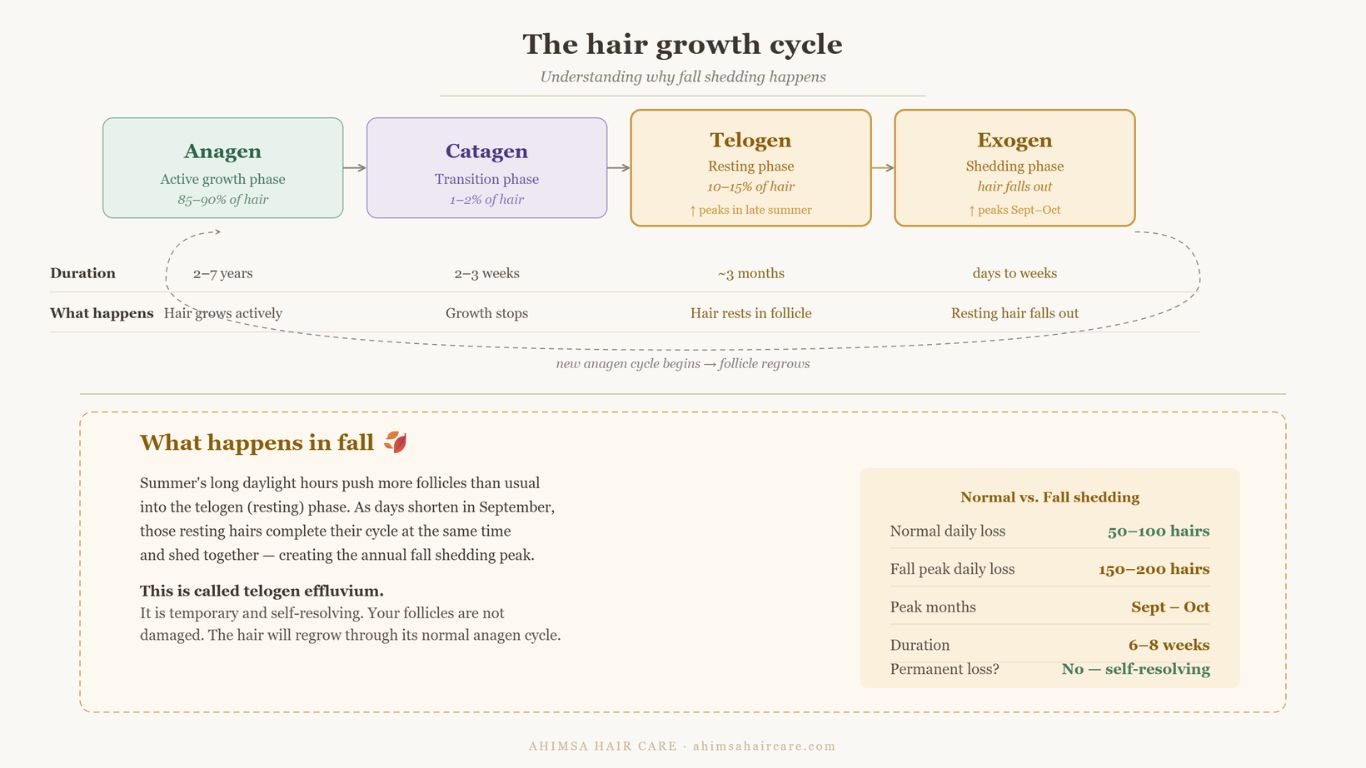 To understand fall shedding, you need to understand the hair growth cycle. Every strand of hair on your head goes through four phases:
Anagen (growth phase): The active growing phase. Each hair grows actively for 2–7 years. About 85–90% of your hair is in this phase at any given time.
Catagen (transition phase): A short transitional phase lasting 2–3 weeks. Growth stops and the follicle prepares to rest.
Telogen (resting phase): The hair rests for approximately 3 months before shedding. Around 10–15% of your hair is in this phase at any given time.
Exogen (shedding phase): The resting hair falls out and the follicle begins a new anagen cycle.
Telogen effluvium is the clinical term for an unusually large number of hairs shifting into the telogen phase at once. The result is a synchronized wave of shedding weeks or months later.
In the context of seasonal shedding, research suggests that long summer daylight hours push a larger-than-normal percentage of follicles into the telogen phase. Then, as days shorten in autumn, those resting hairs complete their cycle and shed together — creating the September/October shedding peak most women notice but few understand.
This is not hair loss in the clinical sense. Your follicles are not damaged or compromised. The hair will regrow through its normal anagen cycle. But the increased shedding can last 6–8 weeks and can feel alarming — especially when it coincides with other stressors your hair is already managing. 🌱
Why Active Women Experience It More Acutely 💪
For active women, seasonal shedding doesn’t exist in isolation. It compounds with the specific hair stressors that training creates — and the compounding effect is what makes fall particularly challenging for your hair. Here’s why:
Traction Stress Adds Up 🎀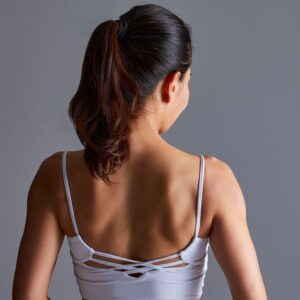
Every workout involves styling your hair. For most active women, that means a tight ponytail, a high bun, or repeated elastic use — same spot, same tension, multiple times per week.
The follicles most vulnerable to traction stress are also the most susceptible to shedding during a telogen effluvium event: the temples, hairline, and crown. When seasonal shedding arrives in September, those follicles are already under mechanical stress from months of workout hairstyles. The combination means higher visible shedding at exactly the places you least want to lose hair.
This is why the hairstyle choices you make during workouts matter year-round — but especially in fall. Reducing traction during the seasonal shedding window gives vulnerable follicles the best chance to move through their cycle without additional mechanical disruption.
Sweat and pH Disruption 💧
Active women deal with repeated scalp pH disruption throughout the training season. Sweat is acidic and shifts the scalp’s pH outside its optimal 4.5–5.5 range with every session. Over summer — typically the highest-volume training period for outdoor athletes — that pH disruption accumulates significantly.
A scalp microbiome already disrupted from months of training is a less resilient environment. Follicles transitioning through a shedding phase need a stable, balanced scalp to complete their cycle cleanly. Chronic pH imbalance from summer training makes that harder.
The Transition to Indoor Training 🏋️
For many active women, September marks the shift from outdoor to indoor training. That transition brings two hair-specific changes: reduced UV exposure (which actually benefits the hair shaft) but significantly drier indoor air from heating systems. Dry indoor air draws moisture from the hair shaft and scalp. This increases brittleness and breakage at exactly the moment when hairs are already shedding at an elevated rate.
If your training shifts from outdoor runs to indoor sessions in fall, your hair care routine needs to adapt to the new environment — not just the new season.
What Normal Fall Shedding Looks Like — and When to See a Doctor 🩺
It’s worth being clear about what’s normal and what isn’t. Normal seasonal shedding typically:
- Begins in September and resolves by November
- Involves noticeably more shed hairs in the shower, brush, and on pillowcases
- Does not create visible patches or bald spots
- Does not involve broken short hairs at the scalp (which suggests breakage, not shedding)
- Is distributed evenly across the scalp, not concentrated at one point
If your shedding is patchy, concentrated in one area, involves very short broken hairs at the roots, or continues past November without improvement, it’s worth speaking with a dermatologist. Those patterns can suggest alopecia areata, traction alopecia, or nutritional deficiencies that benefit from professional assessment.
However, the vast majority of September and October shedding in otherwise healthy women is seasonal and self-resolving. The strategies below are about supporting your hair and scalp through that process — not reversing it. 🌿
What to Do: The Fall Hair Care Response 🍂
Seasonal shedding cannot be stopped — and it shouldn’t be. It’s a healthy biological process. But you can significantly reduce the visible impact. You can protect vulnerable follicles that are cycling through and create scalp conditions that support the fastest return to the anagen growth phase. Here’s how:
1. Reduce Traction During the Shedding Window 🎀
September and October are the months to be most deliberate about your workout hairstyling choices. Lower your ponytail. Switch from a tight high bun to a loose low bun. Braid instead of elastic-only styles. Vary your style placement from session to session.
This doesn’t mean abandoning your workout routine or your hair. It means making small adjustments that reduce mechanical load on follicles that are already in an active shedding phase. For specific guidance on which hairstyles minimize traction, see our complete breakdown of the best hairstyles for every workout. 💚
Also switch to seamless elastics or silk scrunchies if you haven’t already. Metal-core hair ties create a cutting action on the hair shaft with every use — during a shedding phase, that mechanical damage adds to an already elevated loss count.
2. Protect and Nourish the Scalp 🌿
Fall is the right time to be more intentional about scalp care. Your scalp is transitioning from summer — potentially months of sweat, sun, and salt — into a drier, cooler environment. Supporting that transition actively means:
Cleanse gently and strategically. If you’ve been washing daily through the summer, now is the time to step back to 2–3 times per week. Daily washing during a shedding phase can increase the hairs lost per session through simple mechanical manipulation. Less frequent washing with Ahimsa’s Gentle Daily Shampoo — sulfate-free and pH-balanced — gives your scalp the cleanse it needs without unnecessary disruption.
Add a monthly purifying cleanse. The transition from summer to fall is also a good time for a scalp reset using Ahimsa’s Purifying Shampoo. Summer training accumulates buildup — sweat residue, salt, sunscreen, product — that sits in the follicle opening and creates an inflammatory environment. A single thorough purifying cleanse at the start of fall clears that layer and gives your follicles a clean starting point for the new season.
Use your Dry Mist Shampoo more consistently. Between-wash scalp management matters more in fall. Active women often train indoors in heated spaces that dry the scalp significantly. Ahimsa’s Dry Mist Shampoo applied after training days neutralizes sweat and maintains scalp balance without the drying effect of daily washing. 💨
3. Increase Moisture Protection 💧
As humidity drops in fall, your hair shaft loses moisture more easily. That dryness makes shed hairs more visible — dry hair snaps at shorter lengths, adding to the apparent loss count. The hairs that remain become more brittle and prone to breakage.
Apply Ahimsa’s Leave-in Conditioner on every wash day — to damp hair, from mid-shaft to ends. This is the single most effective step for protecting hair moisture in the transition to fall. It seals the cuticle against dry air and provides the slip that makes detangling gentler on already-vulnerable shed-phase hair.
Follow with a light application of Ahimsa’s Hair & Body Oil Mist to the lengths and ends. In low-humidity environments, the oil mist creates a barrier that dramatically slows moisture loss between washes. For active women training in heated indoor gyms, this extra sealing step is particularly valuable. ✨
4. Be Gentle with Wet Hair 🌱
Wet hair is at its most vulnerable. The cuticle is open and the hair shaft is under elastic stress. During a shedding phase, rough handling of wet hair increases the apparent loss count. You’re shedding hairs that would have fallen anyway — just forcing them all out at once in the shower.
Finger-detangle before reaching for a comb. Use a wide-tooth comb rather than a brush on wet hair. Work from ends to roots. And always apply leave-in before combing to provide the slip that makes detangling gentle rather than forceful.
5. Consider Your Nutrition 🥦
Fall shedding is primarily a light-cycle and follicle-phase phenomenon — but nutritional deficiencies can amplify it significantly. Iron, zinc, Vitamin D, and biotin deficiencies are all associated with increased telogen effluvium. If your shedding feels particularly severe, it’s worth checking in with your doctor about your levels.
For active women, iron is the most common deficiency to watch. Endurance athletes lose iron through sweat and foot-strike hemolysis. For high-volume runners or cyclists, iron status can affect fall shedding more than most people expect.
From an ingredient standpoint, Ahimsa’s Amla (Indian Gooseberry) — central to our formulas — is one of the most Vitamin C-rich botanicals in traditional hair care. Vitamin C supports collagen synthesis in the follicle and enhances iron absorption — which is part of why Ayurvedic hair care has long emphasized Amla during seasonal transitions. For more on the Ayurvedic herbs in Ahimsa’s formulas, see our full breakdown. 🌿
Your Fall Hair Care Routine at a Glance 🍂
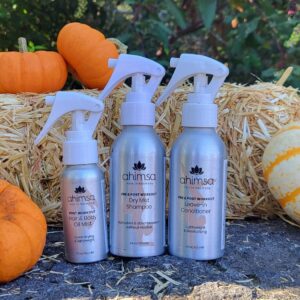 Here’s everything consolidated into a simple fall routine:
On Training Days
- Apply Leave-in Conditioner before styling — protective barrier and moisture seal
- Style low and with minimal traction — loose braids, low buns, seamless elastics
- Apply Dry Mist Shampoo after training — scalp reset without washing
- Finger-detangle before using a wide-tooth comb
On Wash Days (2–3x per week)
- Cleanse with Gentle Daily Shampoo
- Apply Leave-in Conditioner to damp hair
- Seal with Hair & Body Oil Mist on lengths and ends
- Detangle gently with wide-tooth comb while product is in
Once at the Start of Fall
- One purifying cleanse with Ahimsa’s Purifying Shampoo to clear summer buildup
Throughout September and October
- Lower your workout hairstyle placement
- Switch to seamless elastics
- Handle wet hair as gently as possible
- Be patient — the shedding phase lasts 6–8 weeks and resolves naturally 💚
What Comes Next: Preparing for Winter 🌿
As fall shedding resolves in November, your hair enters a period of natural regrowth — new anagen hairs emerging from the follicles that completed their resting phase. That regrowth window overlaps with the arrival of winter, which brings its own set of hair stressors: cold air, indoor heating, static, and wool hat friction.
The habits you build now carry directly into winter: gentle handling, consistent moisture protection, reduced traction during training. For the full guide to protecting your hair through cold weather, see our Winter Hair Health Guide. 🍂
The Ahimsa Philosophy: Work With Your Hair, Not Against It 💚
Seasonal shedding is your hair doing exactly what it’s supposed to do. It’s not a failure or damage. This is a biological rhythm that has been happening in humans for as long as there have been seasons.
At Ahimsa, we believe that understanding your hair’s natural cycles — and building a routine that supports them rather than fights them — is what healthy hair actually looks like. The goal is not to force a result or panic at a natural process. Just give your hair and scalp what they need to move through each phase as well as possible.
Fall shedding will pass. What you do during it shapes what your hair looks like when it does. 🌿✨
Ready to support your hair through the seasonal transition? Explore Ahimsa’s full collection of clean, sulfate-free, active hair care — designed for every season.
You Might Also Like 🔗
- Hair Up, Game On: The Best Hairstyles for Every Workout
- Running and Your Hair: The Complete Hair Care Guide for Runners
- The Mindful Wash: How Often to Shampoo & Why It Matters
- Scalp Microbiome 101: Why Your Scalp Health Determines Hair Growth
- Winter Hair Health Guide: Ahimsa’s Essential Tips for Cold Weather
- 7 Essential Ayurvedic Herbs for Modern Hair Wellness
Sources 📚
- British Journal of Dermatology: Seasonal Changes in Human Hair Growth
- American Academy of Dermatology: Hair Loss Types — Telogen Effluvium
- NIH: Hair Follicle Cycling and Seasonal Shedding
- PMC: Scalp Microbiome and Topical Treatments
- Journal of the American Academy of Dermatology: Traction Alopecia
- NIH: Iron Deficiency and Hair Loss in Women
- International Journal of Trichology: Telogen Effluvium — A Review
© Ahimsa Hair Care. All rights reserved.