
 0

It starts quietly. A few more hairs in the shower drain. A little extra in your brush. Then one morning, your part looks wider than you remember, and your ponytail feels thinner in your hand. For many women, this is how perimenopause hair loss begins.
If this sounds familiar, you are not imagining it. Perimenopause hair loss is real, it is common, and it has biological causes that researchers have studied for years. 🌿
It can also feel isolating. Nobody warns you that the years before menopause can change your hair as much as they change your sleep, your cycle, and your energy. So when your hair starts shedding, it is easy to blame your shampoo, your stress, or yourself.
At Ahimsa, we believe clear information beats guesswork. This guide builds on our post about why your hair changes after 40 and goes deeper into perimenopause hair loss. You will learn what is happening inside the follicle, which patterns to watch for, when to see a doctor, and what a gentle routine can and cannot do. 💚
First: You Are Not Imagining Perimenopause Hair Loss 🌿
Perimenopause hair loss is one of the most common and least discussed parts of the menopausal transition. One 2023 review estimates that about half of women experience it. In other words, half do not. Severity varies widely from person to person, and genetics play a large role.
So if your hair is changing, you have plenty of company. If it is not, you are not missing anything. Either way, this is not a sign that you did something wrong.
It is also not “damage” in the usual sense. You did not wash your way into thinning hair. The main drivers are internal: hormones, genetics, and the natural aging of the follicle. Your routine matters, but it works at the margins. We will be honest about that throughout this post.
Perimenopause Hair Loss 101: Why Hair Gets Caught in the Middle 📊
Perimenopause is the transition before menopause, and it often lasts several years. Cycles become irregular, and symptoms such as night sweats and hot flashes can appear. Doctors confirm menopause after 12 months without a period, and the average age is about 51.
Your hair follicles are part of this story. They carry receptors for estrogen and for androgens, which are hormones present in every woman. When hormone levels change, follicles respond. Here is what the research shows so far.
Estrogen: A Rollercoaster Before the Drop 🌸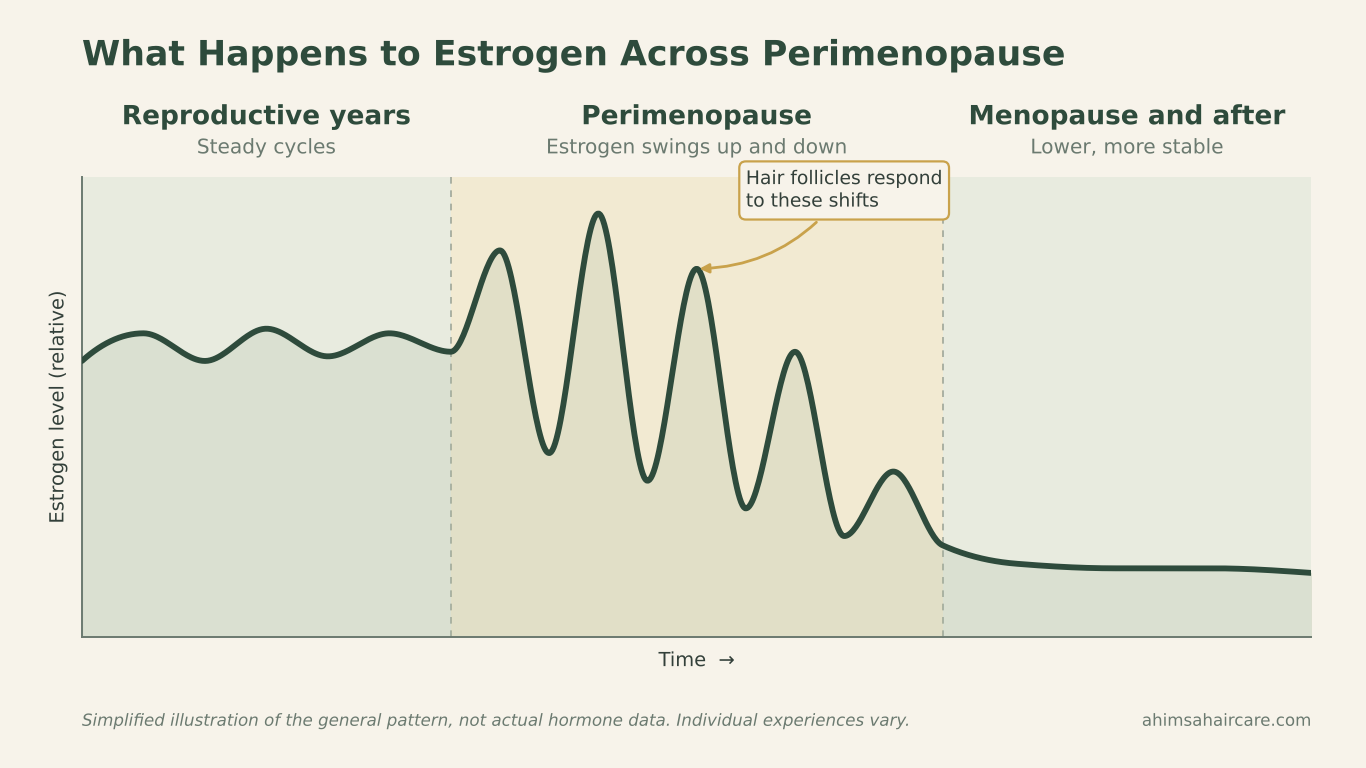
Estrogen helps keep hair in its growth phase, called anagen. Pregnancy shows this clearly. High estrogen brings thick hair, and the drop in estrogen after birth often triggers heavy shedding.
Perimenopause is different from both of those moments. Estrogen does not simply fall. Instead, it swings up and down erratically for years before it settles at the low, stable levels of menopause. Some researchers have proposed that these swings may push more follicles into the resting phase and trigger a long-lasting form of shedding called chronic telogen effluvium. That idea is still a hypothesis. Even so, it fits what many women describe with perimenopause hair loss: shedding that comes in waves rather than all at once.
After menopause, studies show a lower share of hairs in the growth phase. The change appears more clearly at the front of the scalp than at the back. As a result, thinning often shows up first at the front and top of the head.
Progesterone and Androgens: A Shifting Balance 🔬
Progesterone is also in flux. Inside the follicle, it can block an enzyme that converts testosterone into DHT, a stronger androgen linked to follicle shrinkage. Researchers still need to clarify how much this matters for hair. Even so, the idea is simple: when estrogen and progesterone shift, androgens may have more influence over the follicle.
Here is a detail that surprises many women. Most women with female pattern hair loss have normal androgen levels in their blood. So the issue is less about having “too much testosterone” and more about how sensitive your follicles are, which genetics influence.
Stress, Sleep, and Perimenopause Hair Loss 😴
Hormones rarely act alone. Perimenopause often brings poor sleep, higher stress, and a heavy mental load. Physical and emotional stress can each trigger shedding on their own. As a result, a hard few months can add a second wave of shedding on top of the hormonal perimenopause hair loss.
The Look-Alikes That Mimic Perimenopause Hair Loss 🦋
Other conditions can mimic perimenopause hair loss. Thyroid problems are a classic example, because both an underactive and an overactive thyroid can cause shedding. Low iron and low vitamin D are others, and reviews also list zinc and biotin deficiencies. These causes are treatable, which is exactly why they are worth ruling out.
Three Patterns of Perimenopause Hair Loss 💇♀️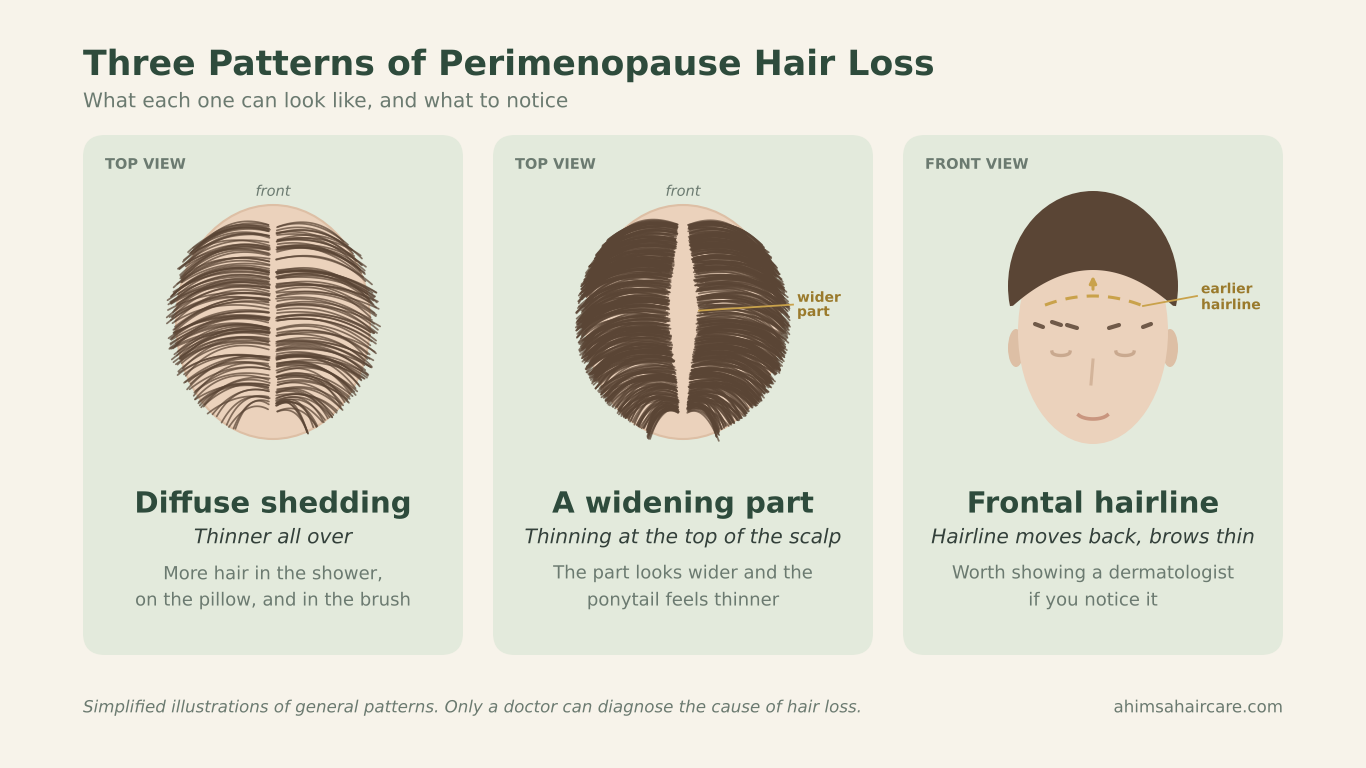
“Hair loss” covers several different conditions. Each looks different, and each calls for a different response. Here are the three patterns that doctors discuss most often at this life stage.
1. Diffuse Shedding: More Hair Everywhere 🚿
With diffuse shedding, you lose more hair than usual from all over your scalp. You see it in the shower, on your pillow, and in your brush. Your part may look about the same, but your ponytail feels thinner. This pattern of perimenopause hair loss often reflects telogen effluvium, and hormonal swings, stress, illness, or low nutrient levels can all trigger it.
Seasonal shedding can stack on top of it, too. If your shedding peaked this fall, our post on why hair sheds more in fall explains the seasonal part.
2. A Widening Part: Female Pattern Hair Loss 📉
Female pattern hair loss is the most common cause of hair loss in women. It usually starts in midlife, and it has a strong hereditary component. Instead of shedding everywhere, you notice thinning over the top of the scalp. The part widens gradually, while the hairline at the front is often preserved.
This pattern tends to progress slowly. It is also the pattern where early treatment makes the biggest difference.
3. Frontal Hairline Changes and Eyebrow Loss ⚠️
A third pattern deserves a clear mention. Frontal fibrosing alopecia is a scarring condition. It makes the hairline recede at the front and temples, and eyebrows often thin as well. Researchers have linked it to the perimenopausal and postmenopausal years.
Because scarring is permanent, early diagnosis matters. If your hairline is moving back or your eyebrows are thinning, see a dermatologist promptly.
Texture, Strength, and Perimenopause Hair Loss 🌀
Many women also notice hair that feels different, not just less plentiful. With age, the hair shaft becomes more fragile, so it handles heat, color, and rough handling less well. As a result, breakage can make thinning look worse than it is. That is good news in one respect, because breakage is something you can reduce.
Shedding or Breakage? A Quick Check 🔍
Shedding and breakage look alike in the brush, but they are not the same problem. Here is a simple way to tell them apart.
Shed hairs are full-length strands. They usually end in a tiny white bulb at the root.
Broken hairs are short, uneven pieces. They have blunt or split ends and no bulb.
Collect a few hairs after brushing and compare them. If most are full-length with bulbs, you are probably seeing shedding. If most are short fragments, breakage likely plays a bigger role. Many women see both at once, and that is normal.
When to See a Doctor About Perimenopause Hair Loss 🩺
This article is educational and does not replace medical advice. Because hair loss has many causes, a dermatologist is the best person to sort out which one applies to you. Other causes can look like pattern hair loss, and each one needs a different treatment.
Make an appointment if you notice any of the following:
- Shedding that is sudden, heavy, or lasts for several months
- A part that keeps widening, or thinning at the crown
- A hairline that is moving back, or thinning eyebrows
- Patches of hair loss, or scalp redness, pain, scaling, or itching
- Fatigue, weight changes, or temperature sensitivity alongside hair changes
When you go, consider asking:
- Is this shedding, pattern thinning, or both?
- Should we check my thyroid, iron, or vitamin D?
- Is minoxidil a good option for me?
- What do my other perimenopause symptoms mean for my treatment options?
Also tell your doctor about every supplement you take. Biotin, for example, can interfere with some lab tests.
Medical Treatments for Perimenopause Hair Loss: A Plain-English Overview 💊
You do not need to memorize any of this. Still, knowing the landscape helps you ask better questions.
Minoxidil is the best-studied option. The FDA has approved 2% and 5% minoxidil for women with pattern hair loss, and you can buy it without a prescription. Expect a wait. You need to use it daily for about six to twelve months to judge the results, and you may notice extra shedding in the first weeks. It can irritate the scalp, and it is not for anyone who is pregnant or breastfeeding.
Prescription medications are another route. Dermatologists sometimes prescribe pills such as spironolactone for pattern hair loss, even though the FDA approved them for other conditions. These medications require a doctor’s guidance and monitoring.
Menopause hormone therapy deserves an honest note. Many women take it for hot flashes and other symptoms. For perimenopause hair loss, however, the evidence is thin. One dermatology review concludes that there is insufficient evidence to support hormone therapy for female pattern hair loss. If you are considering hormone therapy for other reasons, discuss it with your clinician. Just do not count on it as a hair treatment.
Supplements have mixed results. The American Academy of Dermatology notes that most studies found no effect on hair growth or thickness. Check with your doctor before you start any. Correcting a documented deficiency is different from taking a hair supplement “just in case.”
What Doesn’t Help Perimenopause Hair Loss (And Why) ❌
Before we turn to care, a few common instincts are worth rethinking.
Shampoos that promise regrowth. The AAD is clear on this point. Hair loss shampoos can help hair hold moisture and reduce breakage, but they cannot regrow hair or stop hair loss from worsening. Be skeptical of bolder claims, including from brands.
Megadose supplements without testing. More is not better, and you may be treating the wrong problem. Test first, then supplement if a gap shows up.
Tight styles to hide thinning. A tight ponytail or bun puts extra tension on follicles that are already under strain. Looser, lower styles are kinder.
Styling as if nothing changed. Frequent high-heat styling and heavy color can break a more fragile shaft. Dial them down a notch and see what changes.
Waiting a year to find out. If you suspect pattern loss, early evaluation matters. Treatment works best when it starts at the first sign.
What Actually Helps: A Gentle Routine for Perimenopause Hair 🌿
Here is the honest framing. A good routine will not reverse perimenopause hair loss. What it can do is protect the hair you have, reduce breakage, and keep your scalp calm. Those benefits are real, because breakage makes thinning look more dramatic than it is.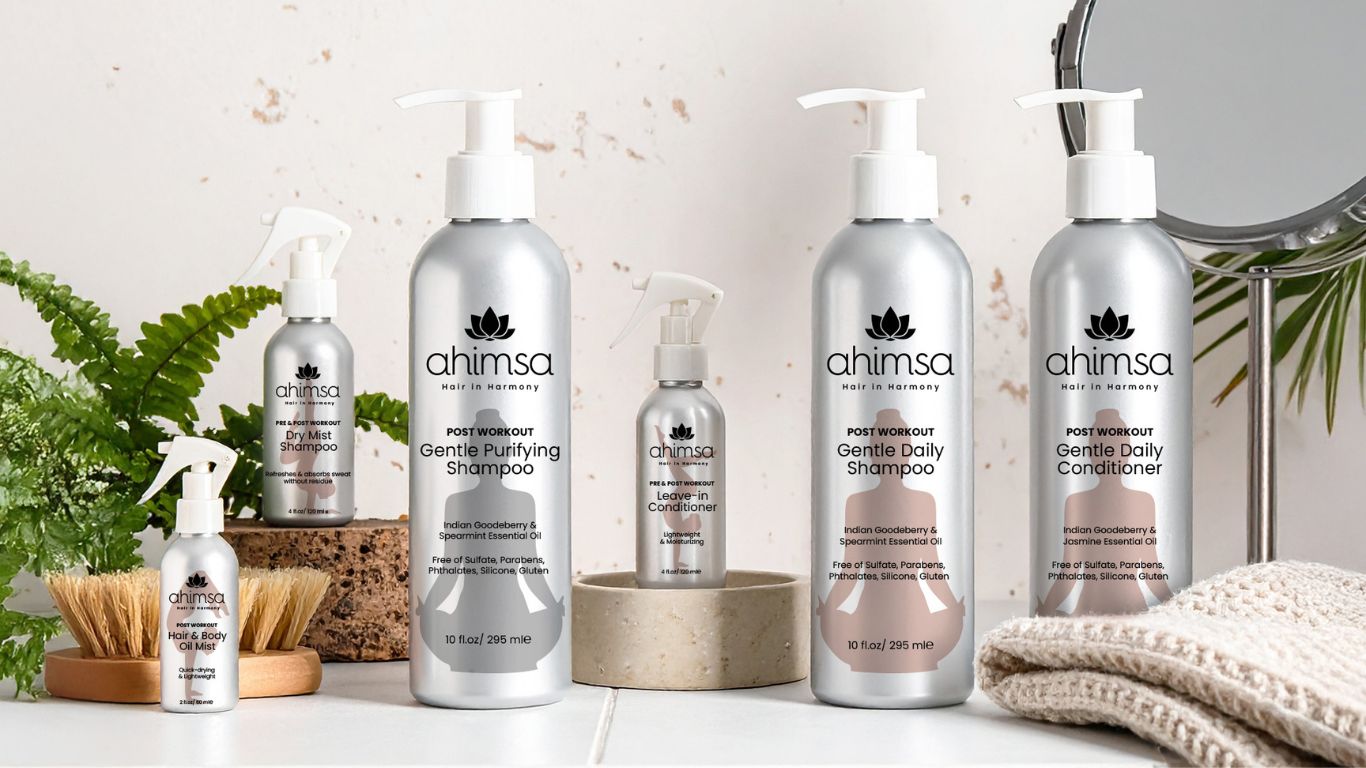
1. Cleanse Gently With a Sulfate-Free Shampoo 💚
Harsh cleansers strip a scalp that may already feel dry or sensitive. Ahimsa’s Gentle Daily Shampoo is sulfate-free and designed to cleanse without stripping. Wash two to three times a week for most hair types. Use your fingertips rather than your nails, and never scrub. If you want the full reasoning, see our guide to how often to shampoo.
2. Refresh Between Washes Without Buildup 💨
Night sweats and hot flashes are part of perimenopause for many women. Sweat on the scalp is still sweat, but daily washing is not the answer. Instead, reach for Ahimsa’s Dry Mist Shampoo on in-between days. It is non-aerosol and powder-free, so it refreshes your roots without propellant or powder residue. For the full story, read the truth about dry shampoo.
3. Add Lightweight Moisture 💧
Finer, drier strands need moisture, but heavy products can weigh thin hair down. Apply Ahimsa’s Leave-in Conditioner to damp hair from mid-shaft to ends. It adds hydration and slip, so detangling puts less stress on fragile strands. If you are not sure how your hair holds moisture, our hair porosity guide can help you find out.
4. Seal the Lengths ✨
Two or three spritzes of Ahimsa’s Hair & Body Oil Mist on the lengths, right after your leave-in, help slow moisture loss between washes. The step takes about ten seconds.
5. Reset Your Scalp Monthly 🌱
Product residue, sweat, and dead skin cells still build up, even when oil production slows. Once a month, use Ahimsa’s Purifying Shampoo for a thorough but sulfate-free cleanse. Willow Bark Extract helps dissolve buildup. A balanced scalp microbiome is the foundation of every other step, so this reset earns its place.
6. Lower the Tension on Your Strands 🎀
Style matters more when strands are fragile. Choose loose, low styles, and use seamless elastics or silk scrunchies instead of tight bands. Detangle on conditioned hair with a wide-tooth comb, and blot rather than rub with a towel. If you train regularly, our guide to the best hairstyles for every workout shows which styles put the least strain on your hairline.
Your Perimenopause Hair Loss Routine at a Glance 🌿
On Wash Days (2–3 Times Per Week)
- Cleanse with Gentle Daily Shampoo
- Apply Leave-in Conditioner to damp hair, mid-shaft to ends
- Seal with Hair & Body Oil Mist on the lengths
- Detangle gently with a wide-tooth comb
Between Washes
- Refresh roots with Dry Mist Shampoo
- Keep styles loose and low
Once a Month
- Reset with Purifying Shampoo
- Take your three hair-log photos (see below)
Track Perimenopause Hair Loss With a 90-Day Hair Log 📸
Perimenopause hair loss unfolds slowly, so memory is a poor measuring tool. A simple log gives you facts instead of worry.
Once a month, take three photos in the same spot and the same light: your part, your crown, and your hairline. Then add a quick note about shedding, stress, sleep, and any new products or medications.
After 90 days, you will see whether things are stable, improving, or progressing. Bring the photos to your dermatologist, too. They make the appointment far more useful. 📸
The Active Woman in Perimenopause 💪
Training can be one of your best allies during this stage. Exercise supports sleep, stress, and overall health, and all of these affect hair indirectly. However, it also adds sweat, friction, and ponytail tension.
Prepping your hair before a workout helps, so our pre-workout hair ritual is a good place to start. A small kit in your bag helps too, like the one in our gym bag hair kit guide. Watch for our next post in this series, which looks at training and hair after 50. 💚
A Word on Expectations 🌱
No shampoo, oil, or conditioner can reverse perimenopause hair loss. We will not tell you otherwise. If a product promises to regrow your hair, ask to see the evidence.
What good hair care can do is meaningful and honest. It supports a calm scalp, limits breakage, and helps the hair you have look and feel its best. If you also pursue medical treatment, a gentle routine is a sensible partner to it. 💚
The Ahimsa Philosophy: Meeting This Season Gently 🌿
Ahimsa means non-harm. For us, that applies to your scalp, to the planet, and to the way you talk to yourself about your hair. Perimenopause is a transition, not a failure. Your hair is responding to real changes, and it deserves care that respects them.
Many of our formulas include Indian Gooseberry (Amla), which has a long history in Ayurvedic hair care for supporting scalp health. Our formulas are also sulfate-free, silicone-free, and free of aerosol propellants. 🌿✨
Ready to build a gentle routine for this season? Explore Ahimsa’s full collection of clean, sulfate-free hair care.
You Might Also Like 🔗
- Why Your Hair Changes After 40 (And What to Do About It)
- Why Your Hair Sheds More in Fall (And What to Do About It)
- Scalp Microbiome 101: Why Your Scalp Health Determines Hair Growth
- The Mindful Wash: How Often to Shampoo & Why It Matters
- Hair Porosity 101: How to Identify Your Type & Choose the Right Products
- The Truth About Dry Shampoo: What Most Brands Won’t Tell You
Sources 📚
- American Academy of Dermatology: Female Pattern Hair Loss
- Clinical and Experimental Dermatology: Menopause, Skin and Common Dermatoses. Part 1: Hair Disorders (Kamp et al., 2022)
- Biomedicines: The Menopausal Transition: Is the Hair Follicle “Going through Menopause”? (Rinaldi et al., 2023)
- Dermatology Online Journal: Hormones and Clocks: Do They Disrupt the Locks? (Mirmirani, 2016)
- International Journal of Molecular Sciences: Hormonal Effects on Hair Follicles (Grymowicz et al., 2020)
© Ahimsa Hair Care. All rights reserved.