
 0
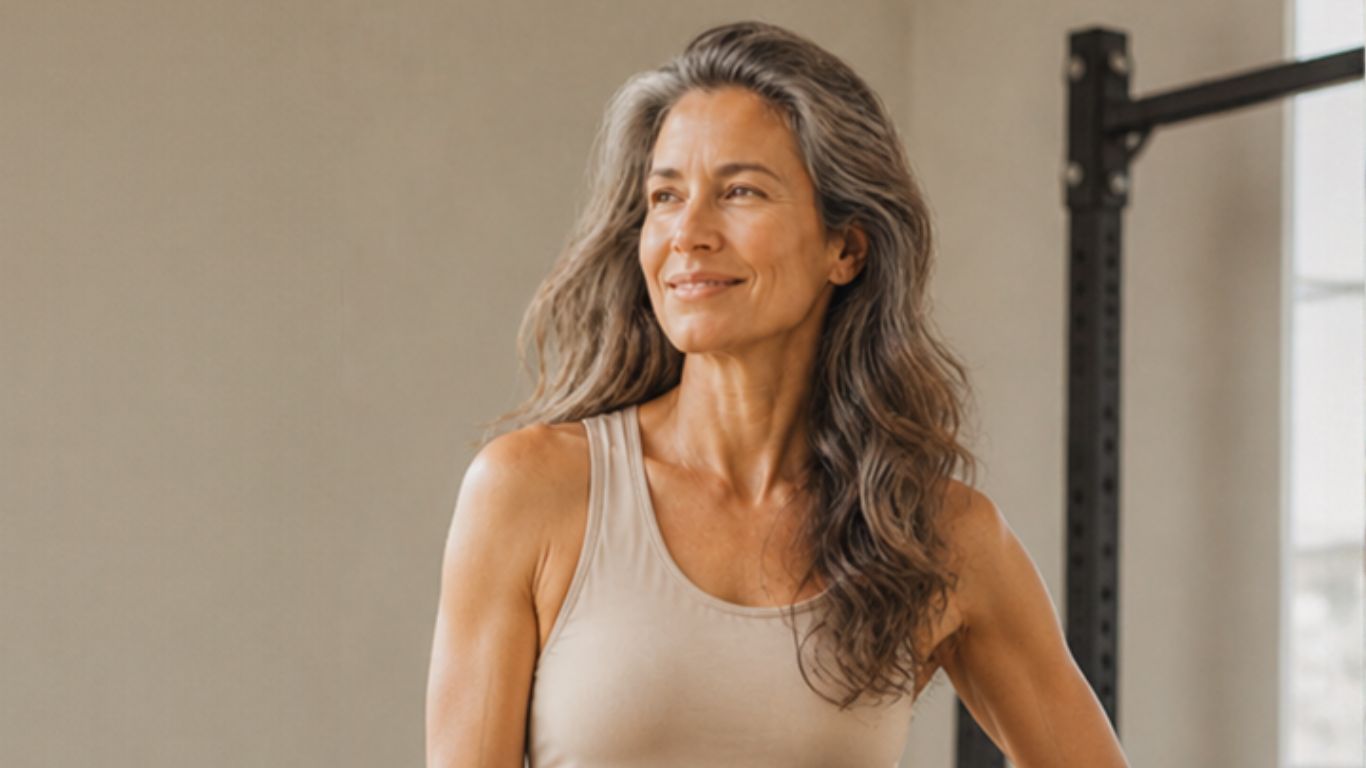
It’s thinner than it used to be. The texture is different — drier, coarser, or both at once. Your scalp feels more sensitive. Products that worked beautifully for years suddenly seem to do nothing, or make things worse. And nobody warned you this was coming.
This isn’t your imagination. It isn’t damage from something you did wrong. Your hair is changing because your body is changing — and those changes are real, measurable, and well-documented in the research. 🌿
At Ahimsa, we believe that understanding what’s actually happening to your hair is the foundation of a routine that works. This post covers the science behind why hair changes after 40, what’s shifting in your hair’s biology, and how to adapt your routine accordingly. 💚
First: This Is Not Hair Damage 🔬
One thing deserves to be said before the science. The hair changes most women notice in their 40s and 50s are not the result of damage, neglect, or the wrong products.
They are the result of hormonal shifts that are entirely normal and affect the majority of women in midlife. Understanding this matters because it changes how you respond. Damage calls for repair. Biological change calls for adaptation.
The goal isn’t to get your hair back to what it was at 30. Understanding what your hair needs now — and building a routine that delivers it — is what this is about.
The Science: What’s Actually Happening 📊
 Hair is exquisitely sensitive to hormonal signals. Every follicle on your scalp has receptors for estrogen, progesterone, androgens, and thyroid hormones. When those hormone levels shift — as they do throughout perimenopause and menopause — the follicles respond directly.
The Estrogen Connection 🌸
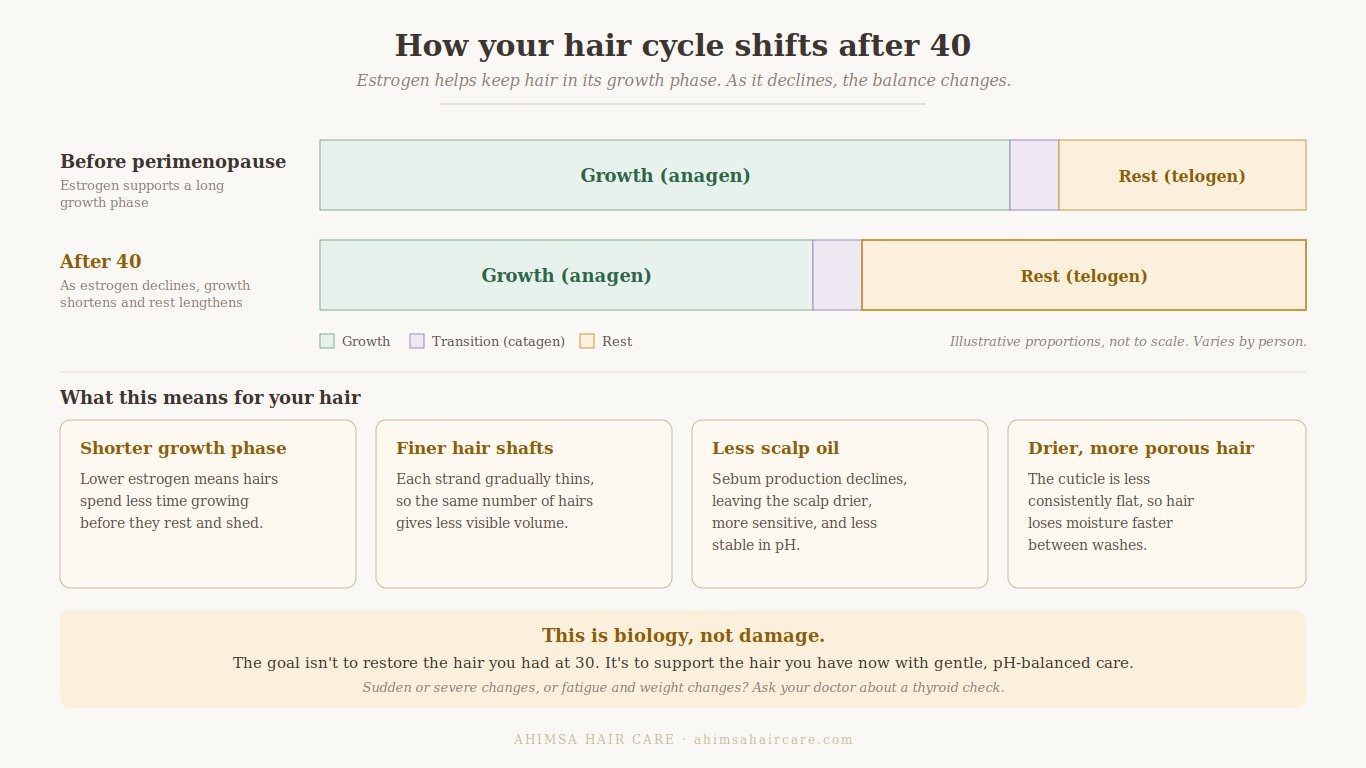
Estrogen is hair’s best friend. Estrogen extends the anagen (growth) phase of the hair cycle, keeping more hairs in active growth for longer — while also supporting scalp moisture balance and the thickness and elasticity of each hair shaft.
As estrogen levels decline in perimenopause — typically beginning in the mid-to-late 40s — several things happen at once. The anagen phase shortens — hairs spend less time growing before transitioning to rest and shed. More hairs sit in the telogen (resting) phase at any given time. The result is a gradual but noticeable reduction in hair density. Follicles aren’t dying — the ratio of growing to resting hairs simply shifts.
The same estrogen decline also reduces the scalp’s natural moisture production and the hair shaft’s ability to retain moisture. Hair that was naturally glossy at 35 becomes increasingly dry and porous at 45. Not because you’ve stripped it — but because the hormonal signals that maintained that hydration have changed.
Androgens and Hair Sensitivity 🔬
As estrogen declines, the relative influence of androgens — including testosterone and its derivative DHT — increases. Hair follicles on the scalp vary significantly in their sensitivity to androgens. Follicles at the crown and temples are more androgen-sensitive than those at the back and sides of the head.
In women with increased androgen sensitivity, this shift can trigger thinning that begins at the part line and crown. This is called female pattern hair loss (androgenetic alopecia). Unlike the diffuse thinning from estrogen decline alone, this pattern is more localized and can be more persistent.
Not every woman over 40 experiences androgen-related thinning. But the hormonal environment of perimenopause makes it more likely to emerge in women with an underlying sensitivity previously masked by higher estrogen.
Thyroid Function and Hair Health 🦋
Thyroid disorders — both hypo and hyperthyroidism — become more prevalent after 40. The thyroid regulates cellular metabolism throughout the body, including hair follicle cells. Both underactive and overactive thyroid function can cause significant hair shedding and texture changes.
If your hair changes in your 40s feel sudden or particularly severe — especially if accompanied by fatigue, weight changes, or temperature sensitivity — a thyroid panel is worth discussing with your doctor. Thyroid-related hair loss is often reversible once levels are regulated.
Scalp Changes: pH and the Microbiome 🌿
The scalp’s own biology shifts after 40 in ways that are separate from but related to the hormonal changes above. Sebum production — the scalp’s natural oil — decreases with age. This reduces the scalp’s natural protective and moisturizing layer. The scalp’s pH balance becomes less stable. And the scalp microbiome — the ecosystem regulating scalp health — becomes more susceptible to disruption.
The practical result is a scalp that becomes more sensitive to harsh ingredients and more prone to dryness and irritation. It’s less resilient against everyday stressors — sweat, styling products, environmental exposure — that it handled easily at a younger age.
What Specifically Changes: A Practical Guide 💇♀️
 Understanding the broad hormonal picture is useful. But what most women want to know is: what exactly is different, and why? Here’s the breakdown:
Hair Density and Volume 📉
The most common complaint among women in their 40s and 50s is that their hair feels thinner and has less volume. This is real — and it’s primarily driven by the shortening of the anagen growth phase described above.
Each individual hair also becomes finer in diameter over time. As estrogen declines, shafts gradually thin — so the same number of hairs produces less visible volume and coverage. This is gradual, typically playing out over years rather than months, but it compounds with the reduced density to create a noticeable overall change in how hair looks and feels.
Texture: From Smooth to Coarse — or Both 🌀
One of the most confusing hair changes after 40 is texture shift — hair that was straight becomes wavy, hair that was fine becomes coarse, or hair that was shiny becomes dull. Sometimes multiple changes happen simultaneously.
Texture changes are primarily driven by two factors. First, reduced moisture content from lower sebum and estrogen causes the cuticle to be less consistently flat and smooth. A rougher cuticle surface is the root cause of both coarseness and dullness. Second, hormonal shifts change the ratio of hair proteins — particularly keratin subtypes — in ways that alter curl pattern and texture unpredictably.
Scalp Sensitivity and Dryness 🌿
Many women notice that their scalp becomes more reactive in their 40s and 50s — itchy, tight, prone to flakiness, or sensitive to products that previously caused no issues. This links directly to reduced sebum production and decreased pH stability.
A scalp that produces less natural oil has less of the protective acid mantle that guards against irritation, microbial disruption, and moisture loss. It’s more easily pushed outside its optimal pH range by harsh shampoo ingredients — particularly sulfates, which are alkaline and highly stripping. A scalp managing fine with natural oil production at 35 finds the same sulfate shampoo far more disruptive at 50.
Porosity Changes 💧
As the hair shaft changes structurally with age — becoming finer, drier, and with a less consistently flat cuticle — its porosity typically increases. Higher porosity hair absorbs moisture quickly but loses it just as fast. Many women over 40 notice their hair feels dry again within a day or two of washing — even after deep conditioning. For a detailed look at how porosity affects your product choices, see our hair porosity guide. 🌿
Growth Rate Slows 📏
Hair grows more slowly after 40. The anagen phase shortens, which means each hair reaches a shorter maximum length before cycling out. Women who wore hair long easily at 30 sometimes find it harder to maintain length in their 40s and 50s. Each strand simply reaches its terminal length sooner — not more breakage, but a shorter growth phase.
What Doesn’t Help (And Why) ❌
Before covering what works, it’s worth addressing what most women try first — because several common instincts actually make things worse.
Washing more frequently in response to a dry or sensitive scalp strips the remaining natural oils that the scalp is already producing less of. This creates a cycle of irritation that makes the sensitivity worse over time. The answer is washing less frequently, not more.
Switching to volumizing shampoos seems logical for thinning hair — but most volumizing shampoos use harsh cleansers and alcohol-based ingredients that strip moisture and coat the hair shaft with silicones. This creates temporary volume while accelerating the dryness and brittleness that are already challenges.
Using heavy conditioning treatments in response to dryness can weigh down fine, thin hair and clog follicles already dealing with reduced sebum flow. The goal is moisture — but delivered in a lightweight, penetrating form rather than a heavy coating.
Aerosol dry shampoos are particularly problematic for scalp-sensitive hair over 40. The propellant residue and powder buildup they leave at the scalp disrupt the already-compromised acid mantle. For a full explanation of why, see our guide on the truth about dry shampoo.
What Actually Helps: Building the Right Routine 🌿
The hair care routine that serves women well after 40 is built around four principles: gentle cleansing, consistent moisture, scalp support, and reduced mechanical stress.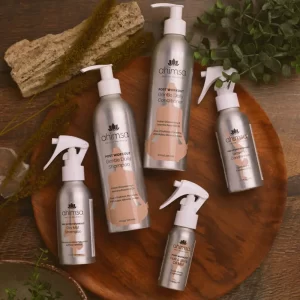
1. Switch to Sulfate-Free Cleansing 💚
This is the single highest-return change for most women over 40. Sulfates — sodium lauryl sulfate (SLS) and sodium laureth sulfate (SLES) — are the primary cleansing agents in most conventional shampoos. They remove oil and buildup effectively — but they’re alkaline and stripping in a way a younger scalp can buffer against but an older scalp increasingly cannot.
Ahimsa’s Gentle Daily Shampoo is sulfate-free and pH-balanced, formulated to cleanse effectively without pushing the scalp’s pH outside its optimal range. For women in their 40s and 50s, this means less scalp sensitivity, less dryness, and a cleaner baseline from which every other product can work more effectively.
2. Reduce Wash Frequency 📅
Most women over 40 are washing their hair too often. With reduced sebum production, the scalp simply doesn’t accumulate oil as quickly as it did at 25. Daily washing at 50 strips a scalp that doesn’t have the oil reserves to compensate.
Two to three wash days per week, with Ahimsa’s Dry Mist Shampoo managing between-wash days, gives the scalp the time it needs to maintain its own balance. The Dry Mist is non-aerosol and powder-free — no propellant residue, no buildup, no disruption to the scalp’s acid mantle. 💨
3. Prioritize Lightweight Moisture 💧
Moisture is genuinely needed after 40 — but the solution has to be specific. Heavy conditioners and oil treatments can weigh down fine, lower-density hair. What works better is a lightweight leave-in conditioner applied consistently — providing moisture that penetrates the shaft without coating it.
Ahimsa’s Leave-in Conditioner is lightweight enough for fine, thinning hair. It seals the cuticle, delivers consistent hydration, and provides the slip that makes detangling gentle on fragile, higher-porosity strands. Apply to damp hair after washing, from mid-shaft to ends. For most women over 40, this is the missing step. ✨
4. Add a Sealing Oil Step 🌿
Higher-porosity hair loses moisture quickly between washes. Adding Ahimsa’s Hair & Body Oil Mist to the lengths after the leave-in creates a sealing layer that dramatically slows that moisture loss. Two to three spritzes on the lengths after the leave-in conditioner — this step takes 10 seconds and makes a visible difference in how hair looks and feels between wash days.
5. Monthly Scalp Reset 🌱
Reduced sebum production doesn’t mean no buildup. Product residue, environmental particulates, and dead skin cells still accumulate at the scalp — and a scalp that’s already sensitive responds to that buildup with more irritation than a younger scalp would.
Once a month, use Ahimsa’s Purifying Shampoo for a gentle but thorough scalp detox. Willow Bark Extract provides gentle salicylic acid action — dissolving buildup without the stripping effect of sulfates. Think of it as clearing the environment your follicles live in. 🌿
6. Reduce Mechanical Stress 🎀
Fine, higher-porosity hair is more vulnerable to breakage from brushing, heat styling, tight hairstyles, and rough towel drying. Each becomes more impactful on hair with less structural resilience than it had at 30.
Detangle gently with a wide-tooth comb, always on conditioned hair. Blot rather than rub with a towel. Choose loose hairstyles over tight updos for everyday wear. If you work out regularly, our guide to the best hairstyles for every workout covers how to style in ways that minimize traction stress. 💚
The Active Woman Over 40: Additional Considerations 💪
Active women in their 40s or 50s face the standard post-40 changes plus the specific stressors of regular training. Sweat, traction from workout hairstyles, and friction from headwear all compound with increased scalp sensitivity and reduced midlife resilience.
The pre-workout hair ritual becomes particularly important after 40. That barrier protection matters more to a scalp with less natural defense than it had before.
Seasonal shedding also takes on added significance for women over 40, who are often navigating hormonal fluctuations that independently increase shedding. For the full picture on seasonal shedding, see our post on why hair sheds more in fall. 🍂
The Ahimsa Ingredients That Matter Most After 40 🌿
Ahimsa’s formulas were built around ingredients that actively support the scalp environment — which makes them particularly well-suited to the post-40 scalp that needs that support more than ever.
Indian Gooseberry (Amla) — Ahimsa’s signature Ayurvedic ingredient, rich in Vitamin C and antioxidants. Amla has a long history in Ayurvedic hair care for supporting follicle health and scalp balance. Its antioxidant properties help counter the oxidative stress behind age-related hair changes. Vitamin C also supports collagen synthesis in the follicle — important because scalp collagen production decreases with age too.
Jasmine Essential Oil — provides fragrance without synthetic fragrance compounds. For a scalp that’s become more chemically sensitive after 40, fragrance-free or naturally-fragranced formulas are meaningfully better tolerated than synthetic fragrance blends.
Willow Bark Extract — in the Purifying Shampoo, provides gentle salicylic acid action that keeps the follicle environment clear without the pH disruption that harsh cleansers create. For a scalp producing less natural oil, keeping the follicle opening clear is particularly important for maintaining healthy hair growth.
A Word on Expectations 🌱
The routine above will not reverse hormonal hair changes. No product can do that — and any brand claiming otherwise is not being honest with you.
What a well-designed routine genuinely does is support your hair’s best possible health within its current biological context. It reduces damage from harsh ingredients and mechanical stress, restores the moisture and scalp support that hormonal changes have reduced, and creates the cleanest possible environment for your follicles — which are still very capable of growing healthy hair.
That’s a meaningful and real benefit. It’s just an honest one rather than an overclaimed one. 💚
The Ahimsa Philosophy: Hair That Evolves With You 🌿
At Ahimsa, every stage of a woman’s life deserves hair care built for it specifically. Not products designed for a 25-year-old body, marketed with aspirational language to everyone else.
Your hair after 40 is not broken or failing. It’s responding to real biological changes with real signals that deserve a real response. Understanding those signals — and building a routine that answers them — is what healthy hair at every age actually looks like. 🌿✨
Ready to build a routine designed for where your hair actually is? Explore Ahimsa’s full collection of clean, sulfate-free hair care — formulated without the harsh ingredients that aging scalps can no longer tolerate.
You Might Also Like 🔗
- Why Your Hair Sheds More in Fall (And What to Do About It)
- Scalp Microbiome 101: Why Your Scalp Health Determines Hair Growth
- Hair Porosity 101: How to Identify Your Type & Choose the Right Products
- The Mindful Wash: How Often to Shampoo & Why It Matters
- 7 Essential Ayurvedic Herbs for Modern Hair Wellness
- The Truth About Dry Shampoo: What Most Brands Won’t Tell You
Sources 📚
- American Academy of Dermatology: Hair Loss in Women
- Journal of the American Academy of Dermatology: Female Pattern Hair Loss
- NIH: Estrogen and Hair Growth Cycle
- PMC: Hormonal Effects on Hair Follicles
- International Journal of Trichology: Telogen Effluvium — A Review
- PMC: Scalp Microbiome and Topical Treatments
- NIH: Hair Structure and the Hair Cycle
- Journal of Cosmetic Dermatology: Age-Related Changes in Hair
© Ahimsa Hair Care. All rights reserved.